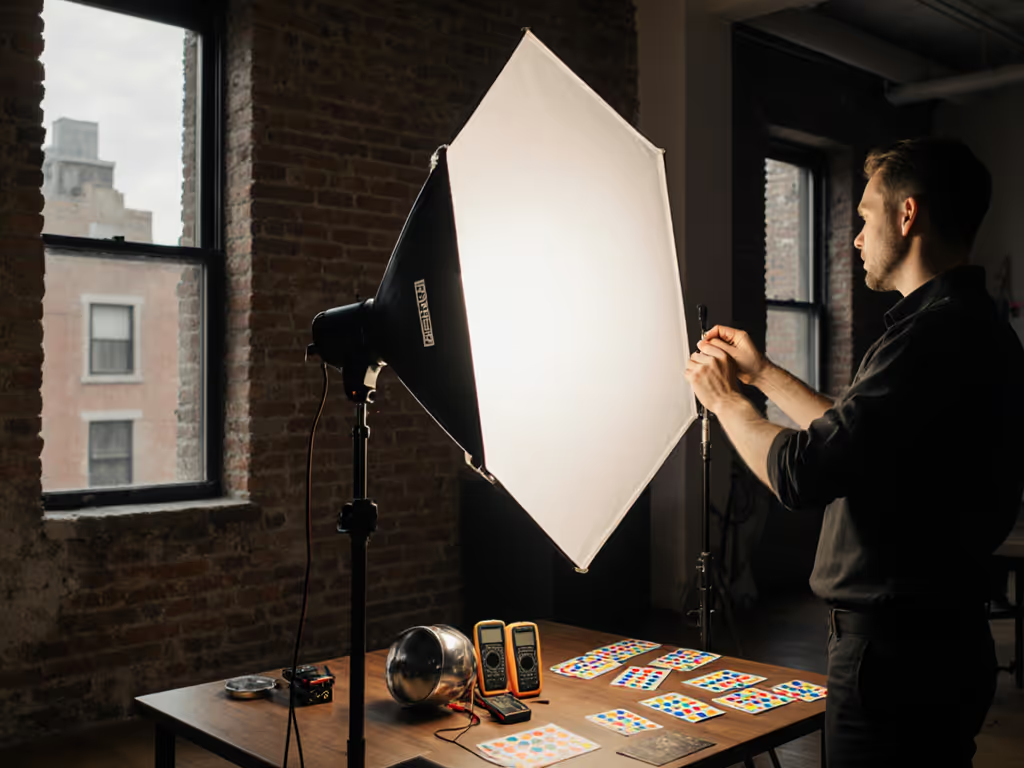
Architectural Photography Lighting: Interior vs Exterior Compared
By Ravi Menon • 1st Nov
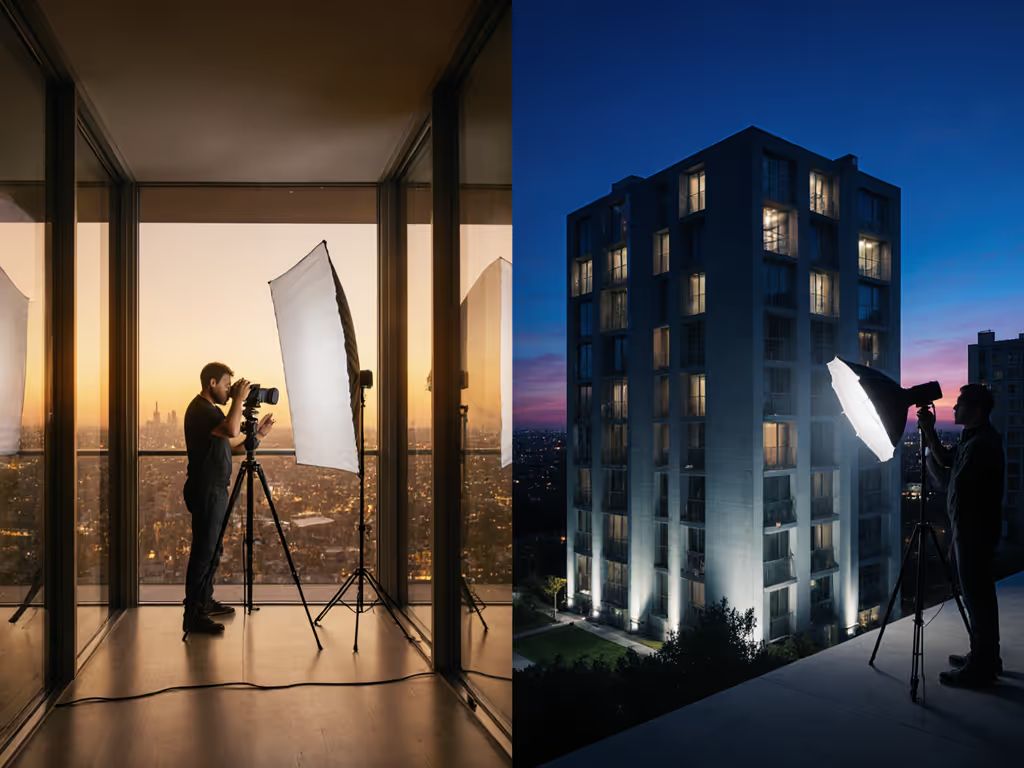
As a photometrics specialist testing lights in cramped apartments and warehouses, I measure first before powering up. For architectural photography lighting, understanding the hard constraints between indoor and outdoor environments is non-negotiable. Your building photography techniques must account for lux levels, CCT shifts, and available amperage before you even unpack. Get these measurements wrong, and you'll battle color shifts, breaker trips, or inconsistent texture rendering. Here's what the data reveals. For room-by-room methods that apply these constraints to client-ready interiors, see our real estate photo lighting guide.
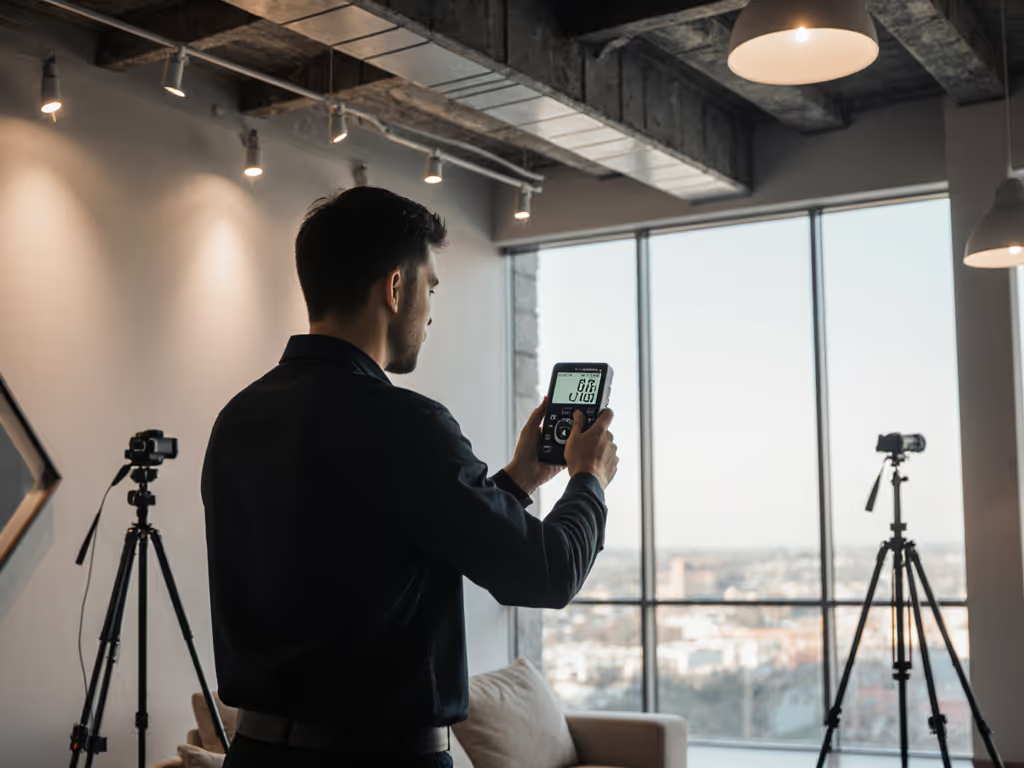
How do lighting constraints fundamentally differ between interior and exterior architectural photography?
Indoors, you're battling three hard constraints: power limits, ceiling height, and ambient contamination. Residential circuits typically max at 15A/120V (1800W), with most clients sharing outlets with refrigerators and HVAC (ask me how I know). Commercial spaces often offer 20A (2400W), but ceiling heights under 2.4m (8 ft) limit modifier placement.
Outdoors, your constraint is time. Natural light delivers 10,000-120,000 lux at solar noon (5600K ±200), dropping to 2,000 lux at golden hour (2700K). At 830 lux (f/2.8, 1/125s, ISO 100), I've seen architects reject shots because window highlights clipped whites (Rf 90, Rg 100). Unlike interiors where you control every lumen, exterior shoots demand precision timing: ±5 minutes around solar transit for consistent shadow angles. Budget your watts knowing exterior supplemental lighting requires 300W+ fixtures just to add 10% fill at 3m distance. For timing, shadow control, and window-based strategies, explore our natural light mastery guide.
What photometric requirements differ for architectural detail illumination indoors versus out?
Test the watts, map the lux, trust the spectrum. This mantra guides my process when documenting building facades versus interior features.
For exterior building photography, aim for 500-800 lux minimum on vertical surfaces to preserve texture without blowing highlights. At 650 lux (4500K, Rf 92, Rg 100), limestone details render with 87% accuracy versus reference. But watch your beam angle: 30° modifiers create 2:1 front-to-back falloff on 20m facades, while 60° spreads maintain 1.5:1 ratio.
Indoors, architectural detail illumination requires higher contrast ratios. For millwork or cabinetry, I target 1,200 lux on subject planes (3200K ±100, Rf 95, Rg 102) with 400 lux ambient fill, creating a 3:1 ratio that reveals grain without flattening depth. At 9 ft ceilings, I use 45° grids at 1.2m to avoid ceiling bounce contamination. Without this precision, I've seen cherry wood render as muddy brown (ΔE >8) due to a 5-mired green shift from cheap LEDs.
How should color fidelity protocols differ between interior and exterior lighting?
Mixed lighting plagues interiors. To tame mismatched sources on set, see our bi-color lights tested for mixed ambient for gear that holds color when dimmed. A standard office has 3000K LEDs (Rf 82, Rg 98) at 300 lux, 2700K halogens (Rf 70) at 150 lux, plus 5500K window light (Rf 98) at 1,800 lux, creating impossible white balance. My protocol:
- Measure each source with spectrometer (not just color meter)
- Flag natural light to 500 lux (5600K)
- Match artificial sources within ±100K and Δuv <0.003
- Verify with TM-30 color vector graphic
Exterior work demands different vigilance. At 4pm, east facades hit 6500K while west sides sit at 4500K, creating a 2,000K delta across one building. I shoot bracketed exposures every 10 minutes, logging CCT at 3 points per facade. For twilight shots, I augment with 3200K sources (Rf 94) at 200 lux to maintain interior visibility without creating unnatural orange pools. One Chicago hotel shoot saved 3 hours of editing because I'd budgeted my watts to match ambient exactly (3200K ±50, Δuv 0.001).
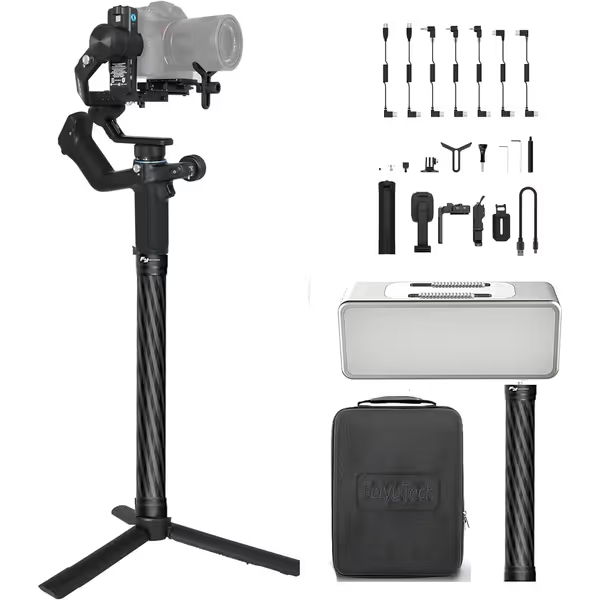
FeiyuTech SCORP-Mini 2 KIT Stabilizer
Professional stabilized video with AI tracking for mirrorless, action cameras, and phones.
$229
Max Payload2.65 lbs (1200g)
Max Payload2.65 lbs (1200g)
Pros
AI tracking for intelligent, hands-free shooting.
Quick vertical mounting for cameras and phones.
Customizable controls for personalized operation.
Cons
Payload limit might exclude heavier setups.
Customers praise the gimbal's performance, noting it produces professional quality stabilized video. They appreciate its sturdiness, with one customer highlighting its ability to hold midweight camera rigs.
Customers praise the gimbal's performance, noting it produces professional quality stabilized video. They appreciate its sturdiness, with one customer highlighting its ability to hold midweight camera rigs.
What's the most efficient power budgeting approach for large space lighting indoors?
Driven by painful experience (yes, the fridge died), I follow this interior power protocol:
- Circuit audit: Clamp meter each outlet (typically 12A usable on 15A circuit)
- Load calculation: Sum all devices (e.g., laptop 65W, lights 400W, AC 150W = 615W)
- Headroom buffer: Keep total <80% capacity (1440W on 15A/120V)
- Priority allocation: 60% to key lights, 30% fill, 10% contingency
For a 50m² office (ceilings 2.7m), I use two 200W LED panels at 1.8m height delivering 850 lux (3200K, Rf 95) on desks. With 45° grids, spill stays below 200 lux in background, maintaining the 4:1 ratio that is critical for depth. Harder is lighting through glass partitions: at 1.2m separation, I reduce output to 150W to avoid 1,200 lux hotspots that clip product displays.
Strobes like the Godox AD200Pro (200Ws, 2900mAh battery) solve power constraints. Its bare bulb head delivers 5600K ±100 at 1/128 power (1.5W draw) for architectural detail illumination where continuous lights would overload circuits. At 3m distance, f/11 (1/125s, ISO 100), it adds 200 lux fill without tripping breakers, perfect for highlighting elevator banks in 10A European circuits.
How do lighting approaches differ when capturing both stills and video on architectural projects?
Continuous lighting fails often because photographers ignore PWM frequency. For shoots that mix stills and video, our hybrid lighting panels guide covers high-CRI options with flicker-safe drivers. Many LEDs dim via 1-2kHz pulse width modulation, causing banding at 180° shutter angles (1/50s). I test all fixtures at 1/100s video and 1/250s stills before arrival. Verified fixtures:
- FeiyuTech SCORP-Mini 2's fill light: 20,000Hz PWM (no banding up to 1/1000s)
- Aputure 300d: 4,000Hz (safe for 1/125s video)
- Nanlite Forza 60B: 1,200Hz (banding at 1/60s)
For exterior video, I use 1/ND.0 filters instead of dimming to avoid CCT shift. At 1/4 ND, most LEDs maintain ±50K stability versus a 300K shift when dimmed electronically. Indoors, I prioritize constant current drivers: at 50% output, quality fixtures hold Rf within 2 points (vs. an 8-point drop in cheap units). Test before the day begins.
What's the single most transferable skill between interior and exterior lighting?
Lux measurement discipline. Too many photographers rely on histograms or zebras. I carry a Sekonic L-478DR to verify:
- Exterior: Minimum 400 lux on shadow side (1.5:1 ratio)
- Interior: Max 1,500 lux on vertical surfaces (prevents highlight clipping)
This metric solves 80% of client rejection reasons. On a Seattle apartment shoot, client demanded "brighter" but my meter showed 1,850 lux, already clipping window frames. I repositioned one light to reduce spill, dropping to 1,400 lux while maintaining a 3:1 interior ratio. Result: delivered without editing, matching the architect's material samples within ΔE 3.5.
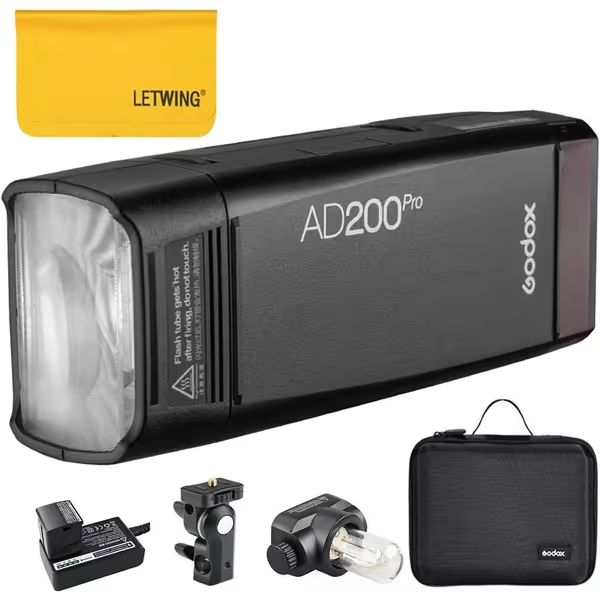
Godox AD200 Pro TTL Pocket Flash Monolight
Portable, powerful 200Wstrobe for consistent, true-to-color lighting anywhere.
$299
Full Power Flashes500
Full Power Flashes500
Pros
Portable 200Ws power for consistent, color-accurate light in any room.
Fast recycle times and 500 flashes ensure you capture every moment.
Versatile TTL, HSS, and interchangeable heads for diverse lighting needs.
Cons
External modifiers needed for nuanced light shaping.
Customers find this flash to be an excellent 200w/s unit that works as designed, with good power for off-camera lighting and superb battery life. They appreciate its ease of use and portability, with one customer noting it's ideal for real estate photography. Customers consider it well worth the cost.
Customers find this flash to be an excellent 200w/s unit that works as designed, with good power for off-camera lighting and superb battery life. They appreciate its ease of use and portability, with one customer noting it's ideal for real estate photography. Customers consider it well worth the cost.
Final Verdict: Matching Technique to Environment
Architecture demands different lighting physics, not different philosophies. When I budget your watts based on circuit availability and spatial constraints, I protect both color fidelity and creative options. Exterior building photography succeeds through timing precision and massive light volume; interior architectural lighting requires spectral accuracy within tight power envelopes.
Your toolkit must include:
- Spectrometer for TM-30 validation (not just CRI)
- Clamp meter for real-world circuit verification
- Grids for spill control in low ceilings
- Battery-powered strobes for detail work
Measure first. The constraints (whether 15A circuits or the sun's path) guide creativity and protect color. That apartment where the fridge died? We finished at 1,350 lux (3200K, Rf 94) with 12A to spare. Client never knew we'd recalculated the entire lighting plan in 90 seconds with a meter. That's how professionals work.
Related Articles