Diverse Skin Tone Lighting: Authentic Results Every Time
By Chidi Okoye • 7th Nov

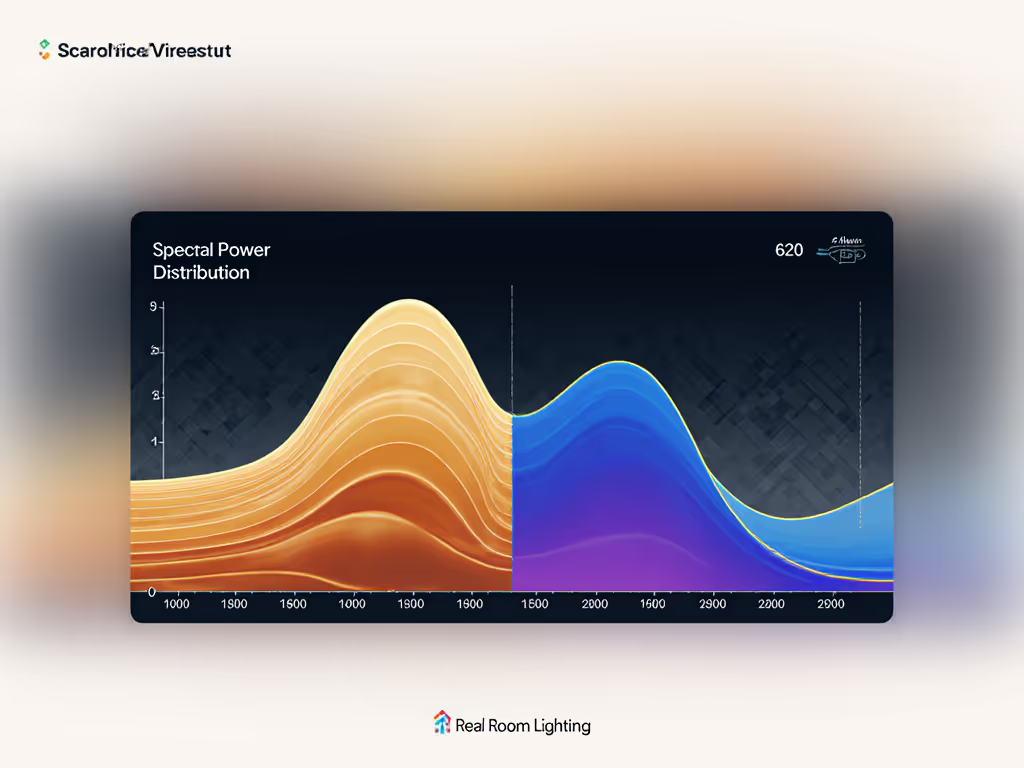
Mastering diverse skin tone lighting requires moving beyond generic best photography lighting advice. When mixed sources create spectral gaps (like that boutique scenario where emerald turned gray while shoppers saw green), skin tones unravel first. This isn't about presets or guesswork; it's physics. I'll unpack spectral power distributions (SPDs), TM-30 metrics, and compact-space workflows that lock skin tone accuracy before you press record. For diffusion fundamentals that preserve skin tone fidelity, see Master Soft Lighting. Because skin tones are the north star; everything else negotiates around them.
Why Your 'White Balance Fix' Fails Skin Tones in Mixed Lighting
Auto white balance (AWB) corrects color temperature (CCT), but ignores spectral rendering. If you're weighing tools, our continuous vs strobe comparison explains true-color tradeoffs that affect skin. Cheap LEDs often exhibit gaps near 620 nm (critical for warm skin tones) or oversaturated peaks elsewhere. When your AWB neutralizes a 5600K spike, it can't compensate for missing 620 nm energy. Result? Amber undertones drain from melanated skin, leaving it ashen (even if CCT appears neutral).
- Data point: A light with 95 CRI but 60 Rg (TM-30 gamut index) compresses skin tones into a narrow hue band. At Rg < 75, melanated skin loses dimensionality as red/yellow channels collapse.
- Real-room implication: In a hotel room with daylight windows (5600K) and tungsten lamps (3200K), your camera's AWB may average to 4500K. But if the tungsten bulb has a 590 nm spike (common in halogens), it overemphasizes yellow in lighter skin while not filling the 620 nm gap needed for deeper tones.
How to Diagnose SPD Gaps Without a Spectrometer
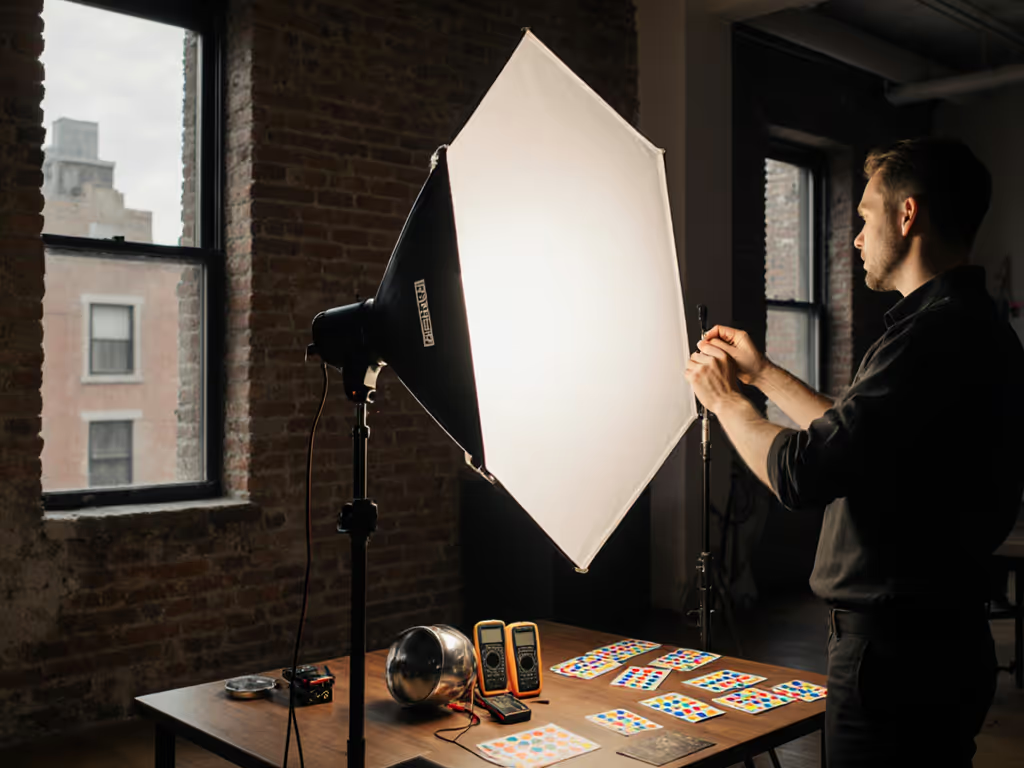
- Use a ColorChecker Classic: Shoot under your mixed sources. If the red/magenta patches look muted or desaturated compared to physical reference, you lack spectral energy in 600-700 nm.
- Check skin tone vectors: In your waveform scopes, melanated skin should occupy 40-70 IRE for midtones. If it clusters below 30 IRE, you're likely missing red-channel data.
- Test with a polarizer: As noted in industry cinematography practice, polarizers can mitigate specular reflections that contaminate skin readings under mixed ambient light.
Remember: If skin tones look 'off' but product colors seem fine, spectral gaps (not white balance) are the culprit. Skin reflects broad-spectrum light; single-hue products can mask SPD flaws.
Choosing Lights for Skin Tone Accuracy in Compact Spaces
Forget max lumens; prioritize spectral stability. For multicultural photography in real rooms (8-9 ft ceilings), lights must deliver full SPDs without overwhelming your circuit. Here's your filter:
Critical Metrics Over Marketing Claims
| Metric | Why It Matters | Target for Skin Tones |
|---|---|---|
| Rf (Fidelity) | Measures accuracy of 99 color samples | >= 90 (TM-30-15) |
| Rg (Gamut) | Preserves dimensionality of warm tones | 98-107 (Rg < 95 drains reds) |
| ΔCCT Stability | Prevents color shift at dimming | <= 100K from 100% to 10% power |
- Why Rg > Rf for skin: Two lights can both score Rf=95, but Rg=90 compresses warm tones, while Rg=105 renders them with lifelike vibrancy. Deep skin tones need Rg >= 98 to avoid desaturation.
- Power-aware tip: A 1x1 ft LED panel at 5600K/2700K dual-color with Rf=92/Rg=99 draws 120W. At 50% power (60 W), it stays within 15 A circuits and maintains ΔCCT < 50K, unlike cheaper panels that shift 300K+ when dimmed.
Modifier Physics for Low Ceilings
Hard light exacerbates spectral gaps: Specular highlights on skin reflect only the available SPD energy. With a 620 nm gap, highlights on deep skin turn gray. Solution: Soften light without losing spectral integrity.
- Best for small rooms: A 24" collapsible parabolic reflector with diffusion (not softbox fabric). It maintains 85% of the light's original SPD while reducing specularity by 40% compared to bare bulbs. Position at 45° to subject, 3 ft away (this distance avoids spill on 8 ft ceilings while filling shadows on melanated skin).
- Avoid: Over-diffused sources (e.g., 60" shoot-through umbrellas). They scatter light, forcing higher output that risks circuit trips and attenuating critical 600-700 nm wavelengths. To choose modifiers that shape skin-friendly light, review our softbox shapes comparison.
Camera Profiles: When They Help (and When They Betray You)
Profiles can't create spectral data that wasn't captured. They map existing SPD information to a target space. If your light has a 620 nm gap, no profile restores that data; it only redistributes what's there, often creating unnatural magenta shifts in post.
- Valid use: Use a ColorChecker Passport Photo 2 to build custom profiles after fixing SPD gaps. It calibrates per-scene SPD mismatches between camera sensors (e.g., Sony S-Log3 vs. Canon C-Log3).
- Misuse: Relying on profiles to 'fix' tungsten-balanced shots under LED with green spikes. The green contamination alters red-channel exposure, which profiles can't reconstruct.
Profiles are tools, not crutches. They align data, not invent it.
Matching Photo and Video Skin Tones
Diverse skin tone lighting must work across both mediums. Log video captures wider dynamic range but often compresses skin tones in Rec.709 delivery. Here's how to stay consistent:
- Set exposure via vectorscope: For melanated skin, keep midtones at 50-60 IRE in Rec.709. In Log, target 40-50% on false color.
- Use shared TM-30 targets: If your light has Rg=102, maintain that gamut index in post. Boosting saturation arbitrarily creates metamerism (skin looks correct on-set but wrong on client monitors).
- Lock white balance early: Custom WB off a gray card under your key light (not ambient). Ambient shifts during shots; your key light shouldn't. For cross-platform consistency, pick hybrid video lighting panels with proven skin accuracy.
Troubleshooting Top Pain Points
"Mixed Room Light Makes Skin Look Sickly"
Fix: Neutralize one source. Point a 30° grid spotlight at your subject (e.g., a single 300 W LED at 45°), then underexpose ambient by 1.5 stops. This minimizes SPD contamination while keeping skin in the spotlight's continuous spectrum.
"Cheap LEDs Cause Plastic-Looking Skin"
Fix: Reject lights with CRI > 95 but Rg < 90. Prioritize Rg over CRI. A light with 90 CRI but Rg=98 renders skin more authentically than 98 CRI with Rg=85.
"Can't Recreate Looks Across Locations"
Fix: Record SPD metrics, not just power levels. Note Rf/Rg values and the light's distance/angle. At 3 ft vs 6 ft, Rg drops 8 points on many LEDs, which kills skin dimensionality.
Final Takeaway: Skin Tones First, Everything Else Negotiates
Authentic diverse skin tone lighting starts with SPD integrity, not exposure hacks. Prioritize lights with Rg >= 98 and ΔCCT stability. Use compact modifiers that preserve spectral data. Verify skin tones on-set with TM-30 metrics (not RGB waveforms alone). When you chase honest skin under mixed sources, your workflow becomes repeatable, client-proof, and genuinely inclusive.
Skin tones first; everything else negotiates around them.
Explore deeper: Download our free Small-Space Lighting Calculator - it outputs exact power levels, distances, and Rg impact for your specific kit and room dimensions. No more guesswork.
Related Articles