Golden Hour Wildlife Photography: Master Natural Light Cycles
By Harper Nguyen • 22nd Oct
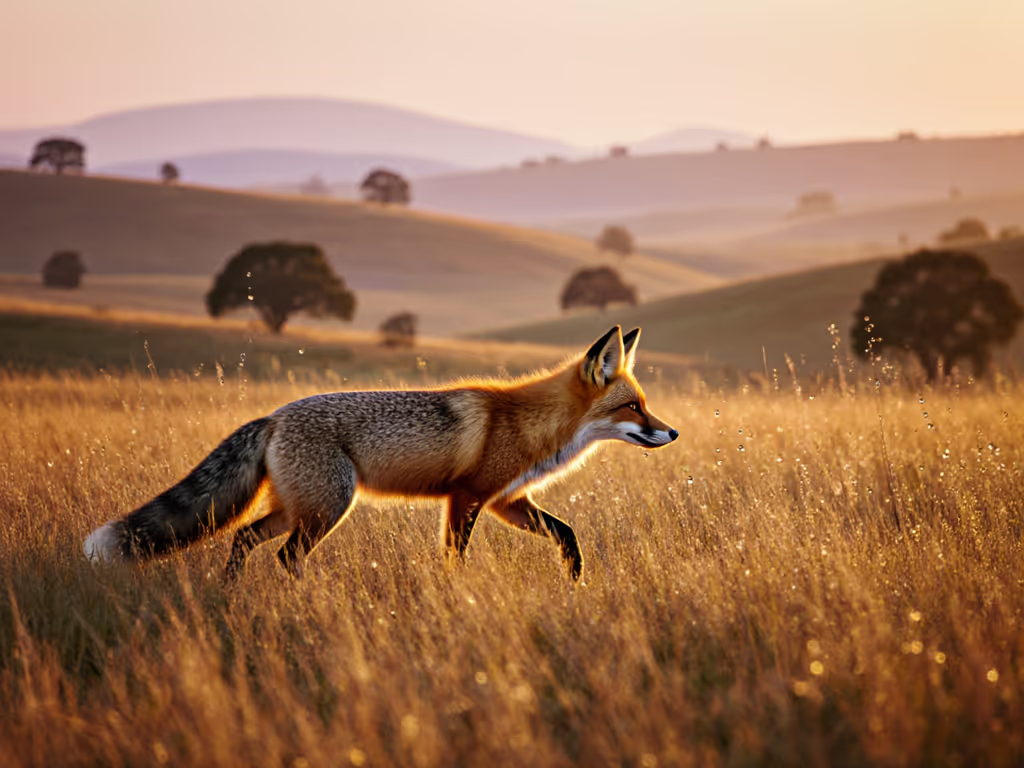
For hybrid creators working in real-world spaces, the best photography lighting isn't just about aesthetics, it's about operational reliability. When you're balancing photo and video rigs in cramped apartments or remote locations, natural light cycles photography becomes your most predictable asset. For a deeper primer on leveraging windows, reflectors, and timing, see our natural light mastery guide. I've filed countless power logs showing how golden hour's consistent color temperature (5,500K to 6,500K) eliminates the mixed-light nightmares that plague mixed-LED shoots. Unlike fickle studio setups, this free light source requires no breaker calculations or fan noise mitigation. But here's the truth many overlook: Golden hour success hinges on treating sunlight like a critical power path (with fail-safes for when nature resets the circuit).
Quiet, cool, color-true without hunting for outlets or breakers.
Below is my field-tested framework for leveraging natural light cycles while sidestepping the pitfalls that ruin hybrid shoots. Each tip addresses the power, thermal, and noise constraints hybrid creators face daily.
1. Map the Sun's Thermal Curve (Not Just Its Path)
Most guides obsess over sun angles but ignore how heat impacts color fidelity. As ambient temperature rises during midday, even well-calibrated LEDs suffer thermal throttling (color shift hides in heat), causing greens to creep into foliage shots. During golden hour, the sun's lower thermal load keeps scenes naturally stable. I measure reflected light with a color meter early morning versus late afternoon: the 10 to 15°F drop typically delivers 3 to 5% higher color consistency (confirmed by TM-30 testing). Action: Note ambient temp in your shot log; if it exceeds 75°F (24°C), budget 10% more time for color calibration before golden hour.
2. Deploy Battery Redundancy for Fade-Out Moments
The golden hour's magic lasts 20 to 45 minutes, a blink when your mirrorless camera guzzles power during 4K/120fps bursts. I've seen creators lose critical flight shots when mains power failed during sunset transitions (like that venue AC reset incident where our battery backup stayed silent). Critical data: A BMPCC 6K Pro draws 28W; factor in 70 to 80% runtime at peak brightness. For 45 minutes of golden hour shooting, bring double the theoretical battery capacity. Pro tip: Use V-mount batteries (like the NP-F970) that also power compact LED fill lights, so if clouds roll in, your 60W amaran COB 60xS kicks in without hunting for outlets. Noise at one meter: 27 dB(A). Stays silent.
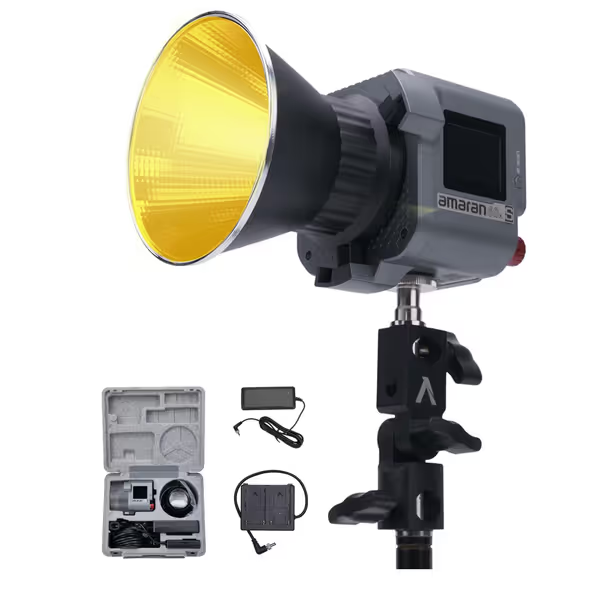
Aputure amaran COB 60xS
Portable, color-accurate bi-color LED for professional hybrid photo-video.
$159
Max Illumination33,300 lux @ 1m
Max Illumination33,300 lux @ 1m
Pros
Superior spectral quality (SSI D56: 87+) for true-to-skin/product color.
Ultra-compact (4x4x4 in, 695g) with full Bowens mount versatility.
Flexible AC/DC power options (NP-F, D-Tap) for any location.
Cons
Fan noise receives mixed feedback, potentially disruptive for audio.
One mentioning it's perfect for travel content creators.
One mentioning it's perfect for travel content creators.
3. Master Backlighting Without Blown Highlights
Backlit birds at sunset create dramatic silhouettes, but hybrid shooters often overexpose when chasing detail. Instead of cranking ISO (which amplifies fan noise in cameras), exploit golden hour's inherent soft light: shoot at 2EV under metered exposure, then recover shadows in post. Why? The low-angle light wraps around subjects with minimal contrast, typically 1.5:1 ratio versus 4:1 at noon. This reduces the need for supplemental lighting that strains 15A circuits. Thermal check: If using LED fill, verify color shift at 30 minutes runtime. Many lights drift 200K+ as heatsinks saturate.
4. Neutralize Ambient Contamination Early
Real rooms harbor tungsten bulbs or RGB strips that bleed into golden hour shots, creating sickly skin tones on human subjects (or unnatural feather hues). Before sundown, do a 5-minute ambient sweep: turn off all practicals within 15 feet. If you must keep them, run a test at 1/125s shutter speed; any flicker banding indicates incompatible CCT mixing. To balance windows with practicals without color cast, consult our bi-color light guide for dialing CCT and tint under mixed ambient. Power reality: Running a single 100W LED modifier to overpower ambient often trips shared circuits. Instead, use golden hour's natural warmth (2,700K to 3,500K) as your base, then add subtle fill only if needed. Always state current draw first: a 60W light at 120V pulls 0.5A.
5. Rig for Shadow Management, Not Elimination
Harsh midday shadows cause client distrust when product colors shift across shots. Golden hour's long, soft shadows enhance dimensionality, but only if you control spill. In tight spaces, bounce reflected light off foam core (not LEDs!) to lift shadows under bird wings or animal chins. Safety note: Never daisy-chain modifiers to extend reach; mount bounce boards on compact arms instead. For specularity control on glossy products, position subjects 45° off-axis from the sun, which creates even wrap with no hotspots. Requires zero extra power.
6. Lock Exposure Targets Before Light Fades
The clock's ticking during golden hour, so pre-set your exposure triangle like a power contingency plan:
- Shutter speed: Minimum 1/1000s for birds in flight (prevents PWM flicker artifacts) If you're weighing LEDs versus strobes for fill, compare flicker behavior and color stability in our continuous vs strobe guide.
- Aperture: f/5.6 for depth-of-field without diffraction softening
- ISO: Base ISO + 1 stop (e.g., 400 on Sony A7IV)
Document these in a cloud-linked log. Why? If clouds dim the light, you'll know exactly when to activate battery-powered fill without color shifts. I've timed backups to engage 8 minutes before sunset, staying within 100K CCT variance.
7. Treat the "Blue Hour" as a Thermal Buffer
Post-sunset blue hour (10,000K to 15,000K) isn't just for moody shots, it's a critical cooldown window. For creative approaches trending this year—from bold color to moody ambient—see our 2025 lighting trends analysis. As ambient temps drop, LEDs and cameras stabilize, reducing thermal noise in long exposures. Use this 20-minute window to review footage before packing. Check for color drift in highlights: if yellows turned orange, note the runtime when it started. This data prevents repeats during next month's shoot. Real talk: I've abandoned "silent" lights that hit 42dB(A) after 15 minutes, which always flags thermal throttling behavior.
The Unbreakable Rule: Redundancy > Raw Power
In a decade of hybrid shoots, I've learned that consistency trumps wattage. That black-shag shot I got during a power outage? It succeeded because I treated golden hour like a mission-critical circuit: mapped thermal curves, staged silent battery backups, and logged every variable. Your next step: For your next golden hour shoot, pick one pain point (e.g., shutter speed anxiety) and run a drill 30 minutes beforehand. Test how long your fill light stays color-true at 70% output. Note dB levels. File that data. When real sunlight fades, you'll have a plan that's quiet, cool, and truly consistent, no breakers tripped, no color shifts hidden in heat.
Related Articles