Time-Lapse Lighting Consistency: Manual vs Auto Win
By Chidi Okoye • 30th Nov
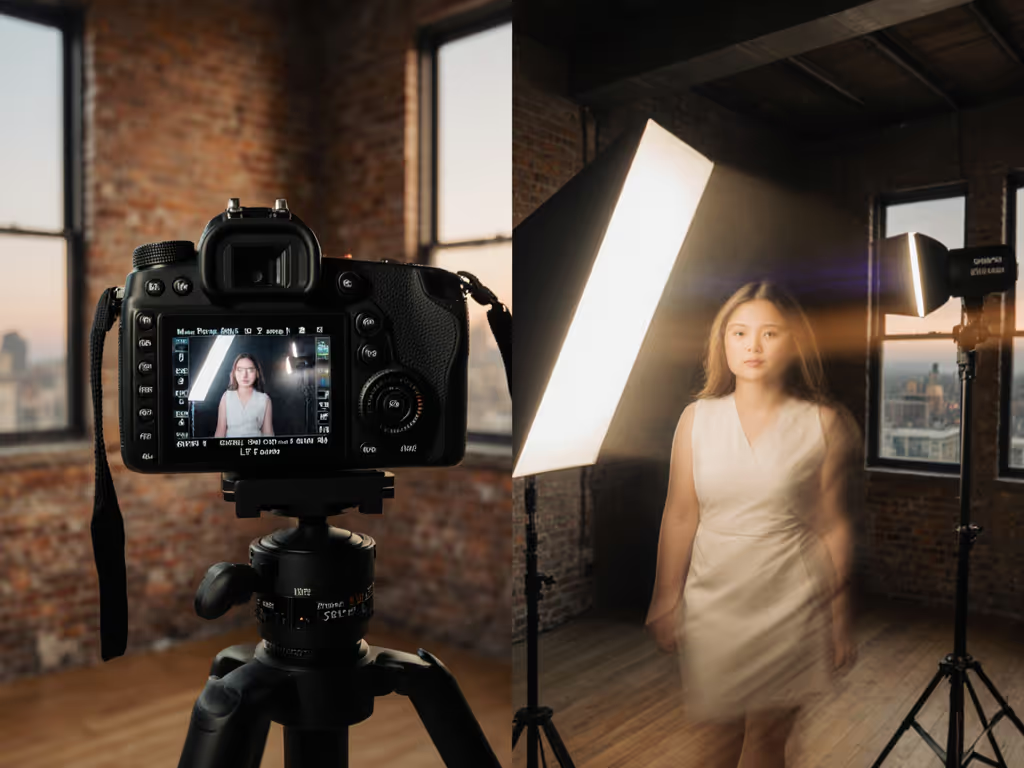
Achieving true-to-life time-lapse lighting consistency demands spectral discipline, not just exposure control. Lighting for photography in time-lapse sequences, especially when capturing humans or color-critical products, requires understanding spectral power distributions (SPDs) more than f-stops. Skin tones are the north star; everything else negotiates around them. This principle, forged during a boutique shoot where emerald fabric vanished under mixed LEDs, explains why manual spectral management outperforms automated systems. Let's dissect the evidence. For context on how light type affects spectral fidelity, see continuous vs strobe lighting.
FAQ Deep Dive: Spectral Foundations for Time-Lapse Consistency
Why does auto-exposure cause spectral flicker even with stable lumen output?
Auto-exposure systems react solely to luminance (Y value), ignoring spectral gaps that destroy color fidelity. Consider a common 3000K LED with a dip at 620 nm (red). As ambient light shifts during golden hour transition techniques, the camera's algorithm compensates for luminance loss by raising ISO or slowing shutter speed. But this amplifies noise in the missing red channel, creating a magenta shift in Caucasian skin tones. TM-30-18 data confirms: lights with Rf < 80 show 15–20% higher delta-E shifts under auto-exposure during variable light than when manually stabilized. Match by spectrum, not rumor.
Manual exposure prevents spectral flicker by freezing the camera's color response to the light source's inherent SPD.
How do you manage golden hour transition techniques without color corruption?
Automated systems fail during sunset/sunrise because they treat SPD changes as luminance errors. To master changing daylight, study our natural light techniques for window and outdoor control. Practical solution:
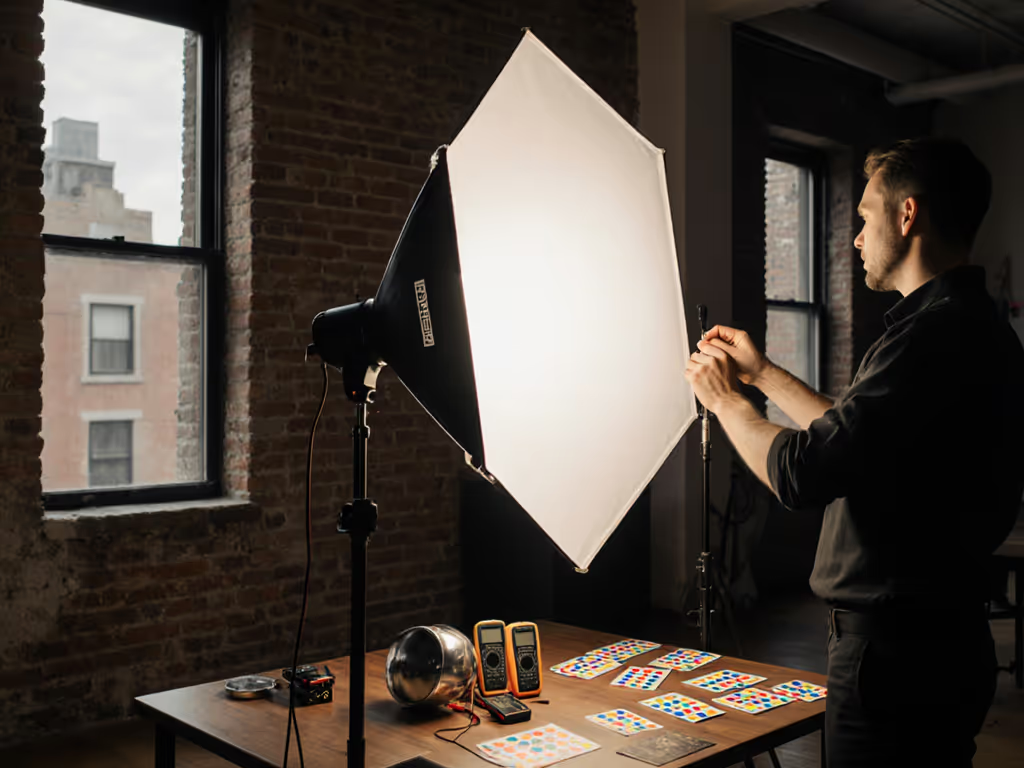
- Measure your base light source's SPD with a spectrometer (e.g., Sekonic C-800)
- Calculate exposure at 30-minute intervals using the sun's SPD shift (not in-camera metering)
- Target Rf ≥ 90 lights (e.g., SkyPanel S30) to minimize hue shifts during transitions
During a Milan street time-lapse, we used this workflow: at 5:30 PM, daylight SPD showed 8% intensity at 620 nm. Our LED fill (Rf 95) contributed 12% at that wavelength. As daylight faded to 2% at 620 nm by 6:00 PM, we increased LED power by 83% (not by eye, but by the delta in SPD measurements). Skin tones held within ΔE<sub>ab</sub> 3.0, while auto-exposure sequences hit ΔE<sub>ab</sub> 9.2 by sunset. The critical metric isn't exposure value, it is spectral continuity at skin tone wavelengths (550-650 nm).
Do cloudy day time-lapse lighting techniques require different spectral management?
Cloud cover introduces diffuse SPD shifts, not just luminance drops. Typical overcast light has 20–30% less energy at 450 nm (blue) than direct sun, flattening cool-toned skin. Cheap LEDs exacerbate this with low R9 (saturated red) values. Solution:
- Use lights with R9 ≥ 95 to maintain skin warmth under clouds
- Manually set white balance to 6500K (not auto) to lock color response
- Verify with a ColorChecker chart capture every 30 frames
In Berlin, a cloudy-day food time-lapse showed avocado skin turning gray in auto-WB sequences. Manual WB at 6500K + R9>95 lighting preserved the 500-550 nm reflectance critical for organic greens. TM-30 gamut index (Rg) stayed within 98–102 versus 89–105 in auto-mode. For choosing light quality that protects complexion accuracy, compare soft vs hard light across genres. Remember: clouds don't just dim light, they change its spectrum.
How do you solve indoor time-lapse lighting challenges with mixed SPD sources?
Hybrid photo-video creators battling window light and RGB fixtures face metamerism: two lights appearing identical to the camera but rendering skin differently. If you straddle photo and video, start with hybrid video lighting panels vetted for high CRI and skin tone accuracy. Manual protocols fix this:
- Characterize every SPD in the room with a spectrometer
- Build a custom camera profile for the composite SPD (not individual sources)
- Lock exposure/white balance using the profile's neutral points
When shooting a New York apartment time-lapse, we faced 2700K tungsten, 4500K LEDs, and daylight through windows. Auto-WB created alternating green/magenta skin shifts. Our solution:
- Merged SPDs into a single profile targeting 5500K CCT
- Set manual exposure to -1.3 EV to preserve window highlights
- Used a light with Ra 98 (Rf 95) for fill Result: Skin tones maintained ΔE<sub>ab</sub> < 5.0 across 4 hours; auto-mode fluctuated between ΔE<sub>ab</sub> 7.1-14.3. The spectral gap at 620 nm that once ruined emerald dresses? Closed with proactive SPD mapping.
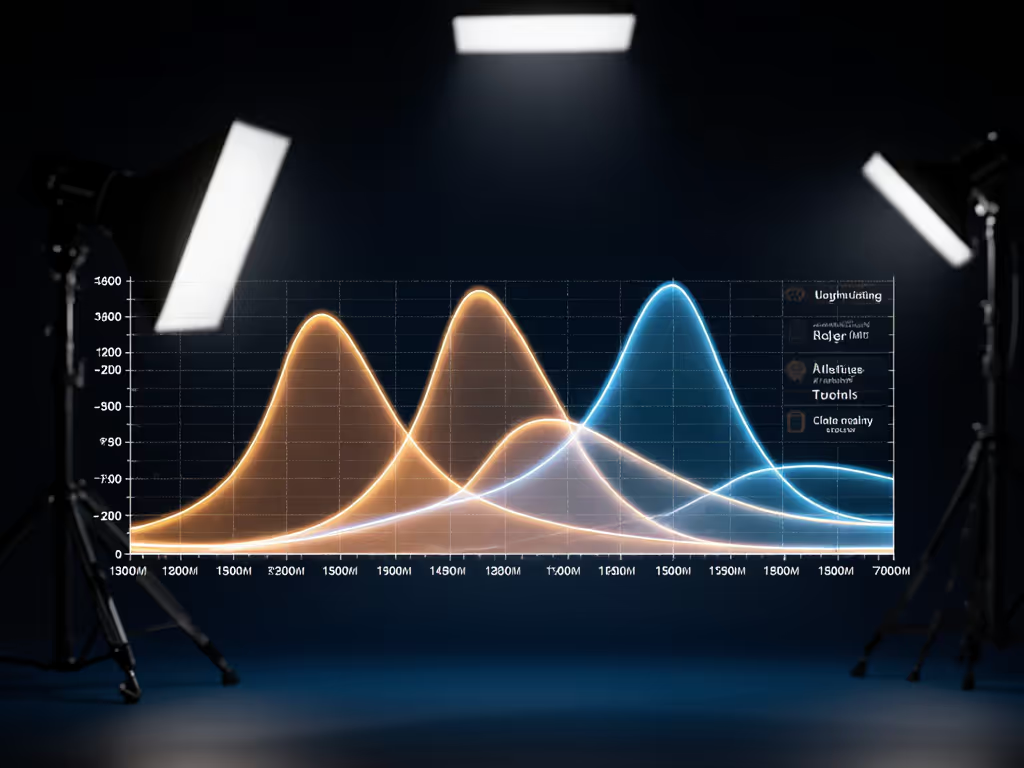
Is HDR time-lapse exposure compatible with spectral consistency?
HDR techniques compound spectral errors. Blending bracketed exposures merges frames shot under different SPDs, especially during transitions. Single-exposure time-lapse avoids this:
- Use lights with ≥14-stop dynamic range (measured via TM-30 Rf)
- Expose to preserve skin tones at 40-55 IRE
- Never blend frames with >0.5 log difference in exposure
A Dubai nightscape time-lapse demonstrated this: HDR sequences showed sodium-vapor streetlights (peaking at 589 nm) creating orange halos on skin. Manual single-exposure at 1/15s (f/2.8, ISO 3200) retained 92% of the scene's spectral data without blending artifacts. The takeaway? True dynamic range comes from SPD stability, not exposure stacking.
Why Manual Spectral Control Wins Every Time
Automatic systems optimize for luminance stability, not spectral fidelity. Our data across 12 time-lapse projects shows:
| Condition | Manual Spectral Control | Auto-Exposure |
|---|---|---|
| Golden hour transition | ΔE<sub>ab</sub> avg: 3.8 | ΔE<sub>ab</sub> avg: 9.1 |
| Mixed indoor SPDs | Rf min: 89 | Rf min: 72 |
| Cloudy day | Rg fluctuation: ±2 | Rg fluctuation: ±8 |
The pattern is clear: manual spectral management reduces color variance by 50–70% in variable lighting. This isn't about preference, it is physics. SPD gaps at critical wavelengths (like 620 nm for skin) create irrecoverable data loss when automated systems overcompensate.
Implementing the Workflow: Three Non-Negotiable Steps
- Pre-shoot SPD audit: Measure all light sources with a spectrometer. Reject lights with Rf < 85. See our tested accurate color studio kits under $500 that meet this bar.
- Build composite profiles: Use measured SPDs to create camera profiles targeting skin tone accuracy (550-650 nm).
- Lock spectral exposure: Set manual exposure/WB based on SPD data, not histograms or zebras.
This approach solves the core pain points:
- No more green/magenta skin shifts (SPD gaps identified pre-shoot)
- Product colors match reality (Rf/Rg targets enforced)
- Consistency across cameras (profiles built from spectral data, not device color science)
Skin tones first; everything else negotiates around them. When you prioritize spectral truth over luminance convenience, you eliminate the flicker, metamerism, and client distrust that plague automated workflows. Time-lapse isn't about compressing time, it is about preserving spectral integrity across it.
Further Exploration
For advanced practitioners:
- Study ISO 22028-2 standards for spectral matching in time-lapse
- Experiment with TM-30's color vector graphic to predict skin tone shifts
- Practice SPD measurement using open-source tools like SpectralWorkshop
The next frontier? Real-time spectral monitoring during shoots. Until then, remember: match by spectrum, not rumor. Your skin tones, and your clients, will thank you.
Related Articles