Cultural Ceremony Lighting: Authentic Skin Tones Guide
By Chidi Okoye • 1st Dec
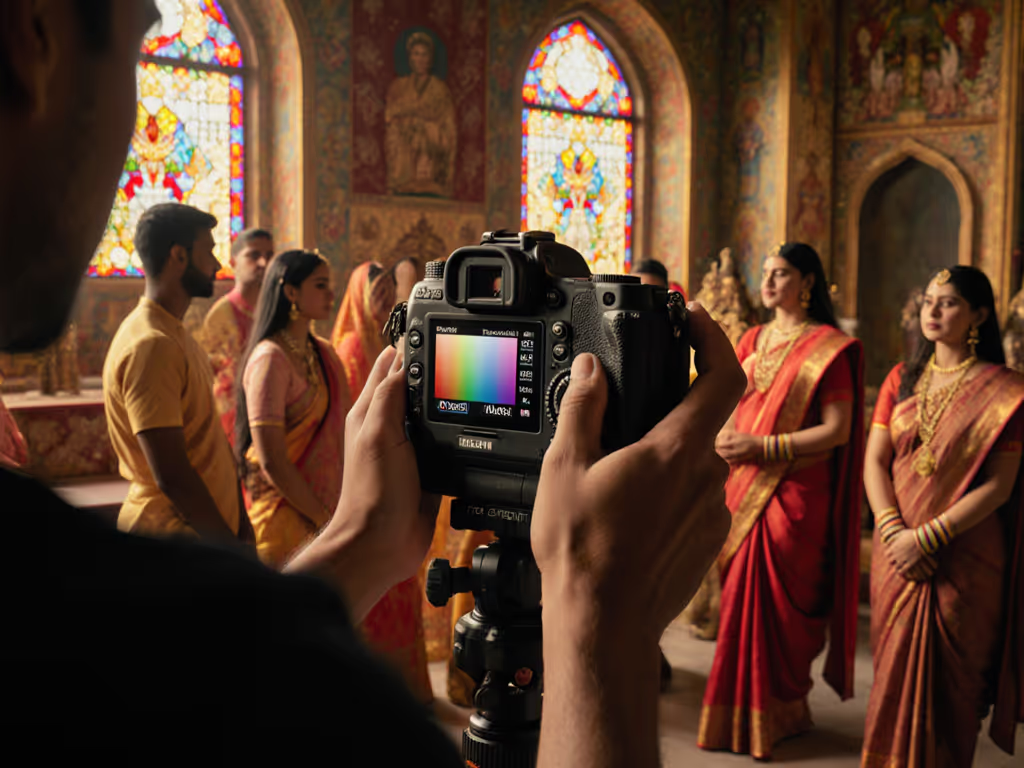
For hybrid creators documenting cultural ceremony lighting, skin tone accuracy isn't just technical, it's ethical. When photographing traditional event photography scenarios, the spectral gaps in your light sources can distort heritage, turning emerald ceremonial garments muddy or rendering skin with unnatural undertones. Let's examine how physics, not guesswork, delivers authentic representation.
Why cultural ceremony lighting challenges skin tone accuracy
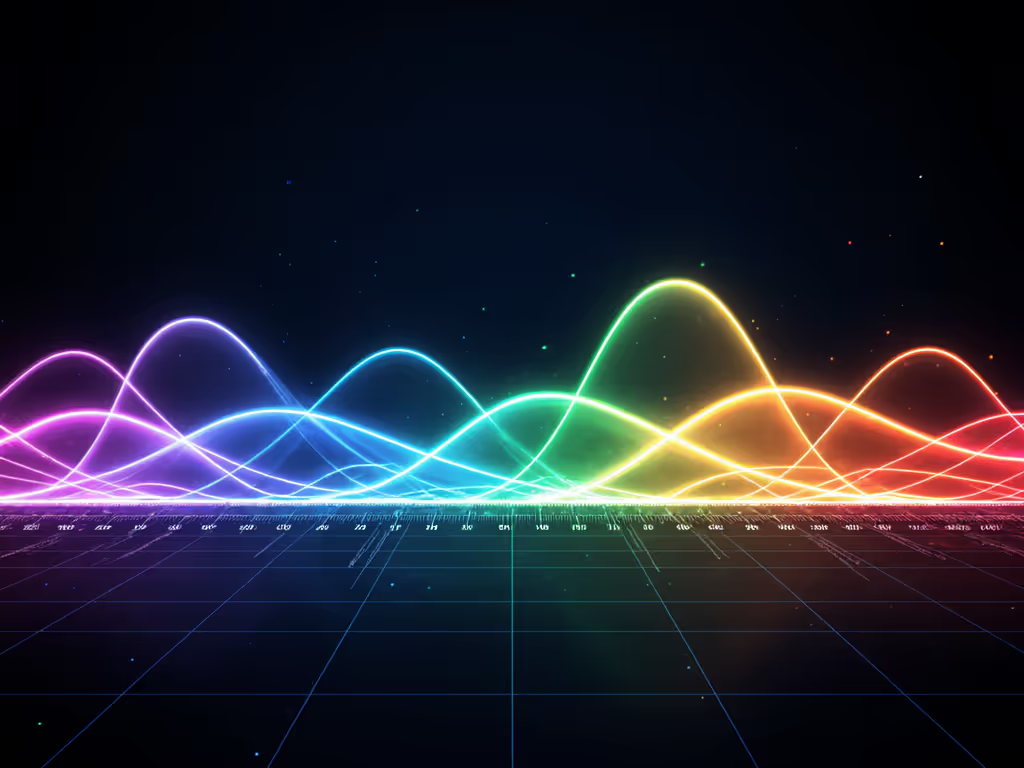
Cultural ceremonies often combine multiple light sources with conflicting spectral power distributions (SPDs). A single venue might mix:
- Incandescent practicals (continuous SPD with strong red emission)
- Fluorescent ambient (peaks at 540nm and 610nm with gaps elsewhere)
- LED stage lights (narrow blue pump with phosphor conversion)
- Daylight through windows (smooth SPD from 400-700nm)
These create metamerism (where two objects match under one light but differ under another). Skin's spectral reflectance curve (peaking at 580 to 600 nm for most tones) becomes particularly vulnerable. A light source with a dip at 620 nm will not render healthy ruddy tones accurately, as I witnessed when a ceremonial garment shifted from vibrant red to dull brown under poor SPD coverage. This isn't just an aesthetic issue, it erodes the cultural authenticity of your event capture.
Measured TM-30 Rf (fidelity) values tell the story: many venue lights score below 80 Rf for Medium Olive skin tones even when hitting 90+ for neutral grays. Skin tones first; everything else negotiates around them. For practical techniques that prioritize inclusive rendering, see our diverse skin tone lighting guide.
How to assess lighting quality without specialized gear
You don't need a spectrometer on every shoot, but understanding SPD characteristics can prevent disasters. If you need portable fixtures that keep skin-accurate color for both photo and video, compare our hybrid video lighting panels. Before setup:
-
Check Rf/Rg metrics in spec sheets: Lights with Rg > 95 and Rf > 90 for skin tones (TCS09-TCS12) indicate strong spectral coverage where it matters. Avoid lights where Rf drops below 85 for these test color samples.
-
Conduct the paper test: Place textured white paper near your subject. If it shows color casts not visible to your eye, your light has SPD gaps. Green/magenta shifts indicate missing red or cyan spectral components.
-
Observe candlelit faces: Human vision adapts to poor light, but cameras don't. Candlelight (1900 K) has continuous SPD despite low CCT, better for skin than 3000 K LEDs with spectral spikes. If faces look healthy to your eyes but sickly on camera, your light source is the culprit, not exposure. To understand how light quality influences complexion and texture, explore soft vs hard light for skin tone accuracy.
This rapid assessment addresses the pain point of "skin tones look sickly under cheap LEDs" by focusing on spectral performance metrics rather than color temperature alone.
White balancing for mixed cultural ceremony lighting
Standard white balance presets fail in mixed lighting environments. Here's a physics-based approach:
Step 1: Neutralize the dominant light
- Use a gray card shot under the primary light source (often ambient room lighting)
- Measure color temperature in Kelvin, but also note the green/magenta offset
- For tungsten-heavy venues, expect offsets toward -M5 to -M10
Step 2: Map secondary sources
- For each additional light source (e.g., window daylight), measure its delta-e difference from your base WB
- If delta-e > 5 from primary source, treat it as contamination
Step 3: Build custom camera profiles
- Shoot an X-Rite ColorChecker under your lighting setup
- Use data to create camera-specific transforms that prioritize skin tone accuracy (TCS09-TCS12)
- Target TM-30 Rf > 92 for skin tones, not just neutral grays
This process solves the "inability to match color across different camera brands" by creating uniform transforms. It requires 10 minutes upfront but saves hours in post, addressing the desire for "true-to-skin color out of camera."
Adapting rituals to small-space constraints
Many cultural ceremonies occur in homes or small venues with 8 to 9 foot ceilings, challenging standard lighting techniques. When traditional modifiers won't fit:
- Use book lights instead of softboxes: Mount diffusion material on existing doors/walls to create large, indirect sources. The effective size becomes the entire surface, not the physical modifier.
- Grid at 30° instead of 10°: In tight spaces, tighter grids cause harsh transitions. Wider grids provide softer falloff within limited working distances.
- Reposition yourself, not the light: With low ceilings, angle your camera to use natural bounce surfaces. A white wall 6 feet to the left becomes your fill light when you shoot toward it.
These ritual lighting techniques address "limited space and low ceilings" while maintaining skin tone integrity. No extra gear required (just understanding how light behaves in constrained environments). For step-by-step diffusion setups that work in any room, study our soft lighting guide.
Measuring cultural sensitivity through color science
Cultural sensitivity photography isn't just about behavior, it is embedded in your technical choices. When documenting ceremonies:
- Verify your light's SPD against skin reflectance curves: Asian and African skin tones reflect more light in the 600 to 700 nm range than Caucasian tones. Lights with weak red emission (below 650 nm) will under-represent melanin-rich tones.
- Check CRI Ra9 specifically: Standard CRI (Ra) uses 8 pastel colors, but Ra9 adds strong red (TCS09). Aim for Ra9 > 90 in critical skin tone work.
- Document your lighting specs: Note SPD characteristics, not just Kelvin. This creates reproducible setups across locations, essential for franchise or multi-venue events.
The SPD plot doesn't lie: A light scoring 95 CRI but with a 620 nm gap will distort warm skin tones despite "good" metrics. True ceremonial color representation requires examining the full spectral story.
Conclusion: Building trust through spectral responsibility
Your lighting choices directly impact how communities see themselves in your images. By prioritizing spectral accuracy over convenience, you honor both the technical craft and cultural context of traditional event photography.
Document SPD characteristics alongside your exposure settings. Create camera profiles specifically tuned for the skin tones present in your subjects. Most importantly, remember that every lighting decision should pass the test: does this serve authentic skin representation first?
For those ready to go deeper: The IES TM-30-20 worksheet provides the most complete framework for analyzing light source performance across skin tones. Pair it with your camera's color science documentation to build truly reliable workflows.
Further exploration into SPD analysis and camera profile creation will empower you to deliver the consistent, authentic representation your subjects deserve, regardless of venue constraints or mixed lighting environments.
Related Articles