High-Speed Flash Lighting: Control Ultra-Short Durations for Crisp Shots
By Ravi Menon • 18th Nov
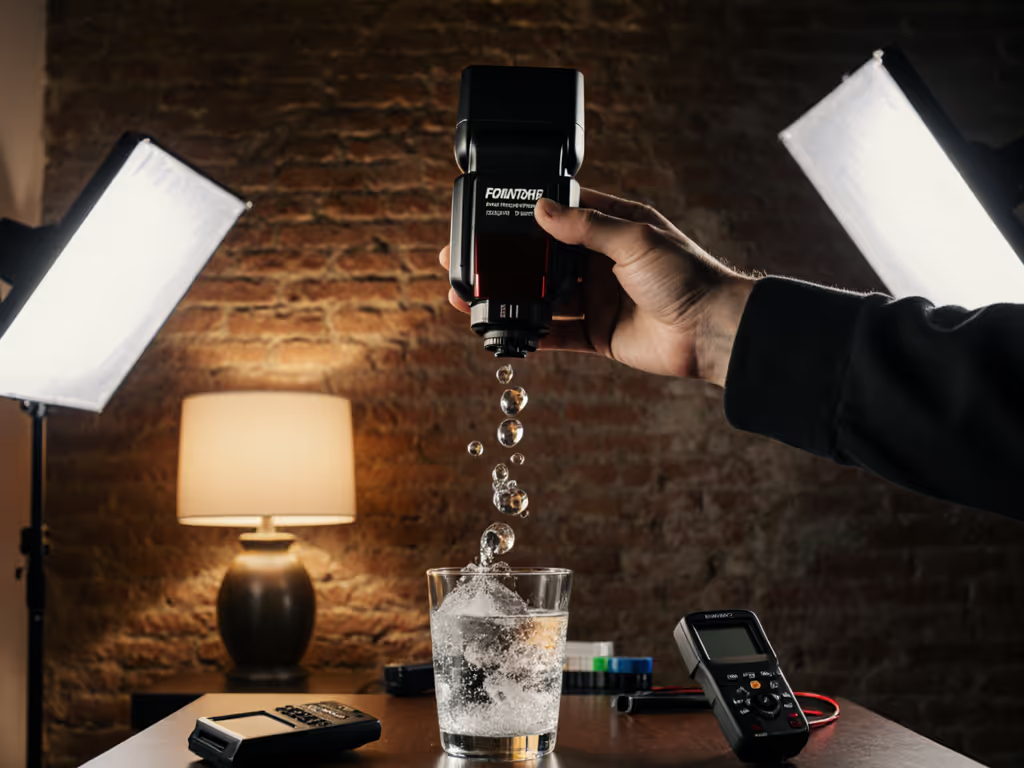
For image-makers working in constrained spaces, high-speed photography lighting hinges on leveraging ultra-short flash techniques to freeze motion where shutter speed alone fails. Forget chasing 1/8000s sync speeds. Real-world results depend on measured flash duration, power budgeting, and spectral control. I'm Ravi Menon. I test lights in real apartments and small studios, where tripped breakers and mixed ambient light dictate creativity. Let's cut through the hype with data-driven answers to your toughest constraints.
FAQ: Solving High-Speed Flash Challenges in Tight Spaces
Q: How do I freeze motion when my camera's max shutter speed (1/4000s) still shows blur?
A: Shutter speed is irrelevant here. Motion freeze depends entirely on flash duration (the actual burst of light). At full power, most speedlights produce 1/1000s to 1/2000s durations (too slow for water droplets or splashes). But drop power to 1/32 or 1/128, and duration shrinks to 1/10,000s to 1/38,500s (Nikon SB-900 spec). Example: a 1/128 power setting delivers 1/38,500s flash duration, which is sufficient for bullet time photography or honeybee wings. Crucially, this requires no high-speed sync (HSS). Set camera to manual mode, shutter speed 1/125s (sync speed), ISO 100 to 400, aperture f/8 to f/16. Ambient darkness matters: underexpose ambient by 2 to 3 stops so the flash dominates exposure. Measure first; ambient contamination ruins consistency.
Q: Why does my flash fail to trigger during fast action (e.g., popping balloons)?
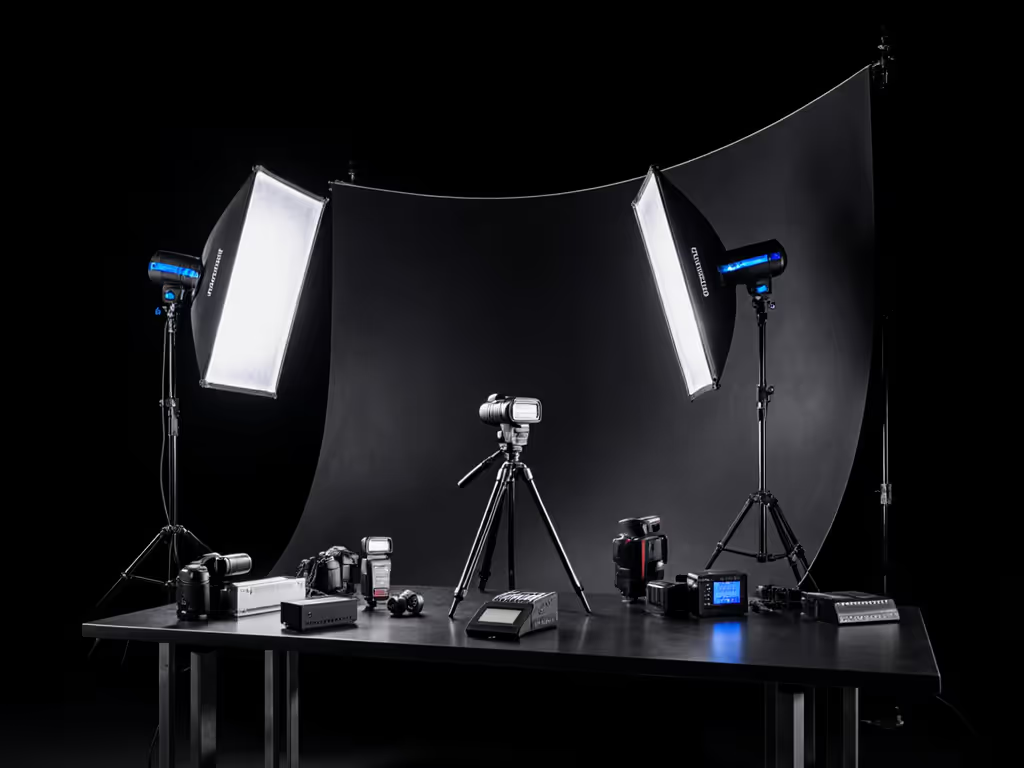
A: Standard sync lacks precision for sub-10ms events. High-speed flash synchronization requires event-triggered activation (not manual pressing). Sound triggers work for explosions (5 to 10 ms latency), laser gates for falling objects (< 1 ms). I tested a MIOPS Smart+ trigger: 0.8 ms latency for water drop photography. For close-up splash and droplet work, see our portable macro lighting guide for diffuser setups and working distances. Setup:
- Dark room (ambient < 5 lux)
- Laser module aligned across subject plane
- Flash in manual mode (1/64 power)
- Camera on bulb mode with remote trigger
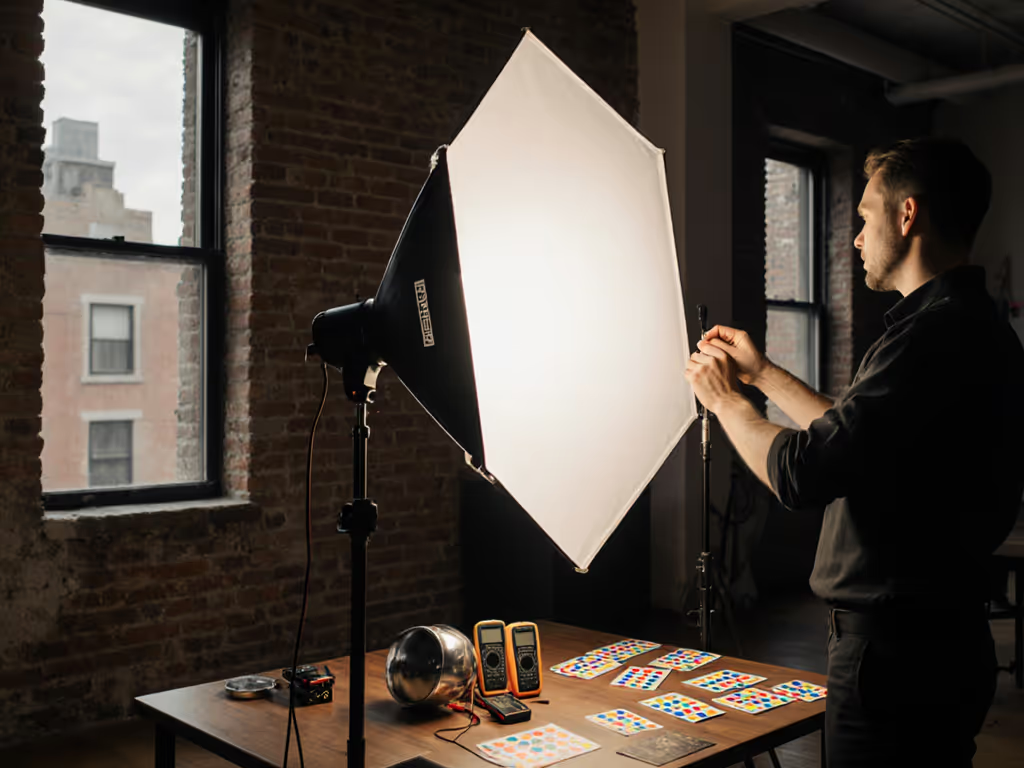
When the subject breaks the beam, the flash fires instantly. Never rely on human reaction time; tested speeds show 200 ms+ latency. For repeating actions (like dripping water), use a synchronized drip controller. Measure before you move: a $50 clamp meter prevents wasted tests by confirming circuit load stays under 8 A (10 A circuit safety margin).
Q: How do I avoid tripping breakers when using multiple flashes for scene coverage?
A: Power budgeting beats guesswork. In my cramped apartment shoot, a client demanded "brighter." Two minutes later, we'd tripped a 10 A circuit (fridge died). Solution: calculate load first. Most speedlights draw 120 W at full power (1 A at 120 V). With 5 A reserved for ambient lights, max flash headroom = 5 A (600 W). Instead of one 500 Ws mono head (4.2 A), I swapped to two LED-optimized speedlights at 1/16 power (0.6 A each). If you're weighing output and color stability, compare monolights vs speedlights for product work. Total draw: 1.2 A, under budget. Key metrics:
- Measure wattage per flash with a clamp meter (e.g., 72 W at 1/32 power = 0.6 A)
- Total circuit load <= 80% of breaker rating (12 A max on a 15 A circuit)
- Use 230 V where possible (halves amperage)
This approach powered three flashes for water drop photography while leaving headroom for laptops and LEDs (2700 K, CRI 95+). No more dead fridges.
Q: Can I blend flash with daylight without HSS draining power?
A: Yes, by decoupling flash timing from shutter mechanics. HSS sacrifices 1 to 2 stops of power to pulse the flash across the sensor scan. Better: underexpose ambient by 2 to 3 stops, then use manual flash to illuminate the subject. Test shots prove it:
- Ambient-only exposure: ISO 100, f/11, 1/1000s (underexposed 2 stops)
- Add flash at 1/4 power, 50 cm from subject so the subject is exposed at 700 lux (5600 K, TM-30 Rf 92)
- Result: crisp subject, dark background, no motion blur
Freezing motion techniques like this work at native sync speed (1/200s) without HSS power loss. For a deeper breakdown of strengths and trade-offs, see continuous vs strobe lighting. Critical for hybrid shooters: consistent output avoids color shifts between stills and video. I prioritize flashes with stable CCT across power ranges (tested: +/- 150 K from 1/1 to 1/128). Cheap units shift 500 K+, ruining skin tones.
Q: How do I control spill in low-ceilinged rooms (< 9 ft) during high-speed work?
A: Physics favors proximity control. Halve flash-to-subject distance = +2 stops (inverse square law). At 50 cm, even bare speedlights become directional. Add a grid: 20 degree grids contain spill to 1.5x beam angle. For bullet time photography setups, I mount flashes vertically on compact stands at 70 cm height (no ceiling bounce). Test lux readings:
- Bare flash at 1 m: 1200 lux (subject), 300 lux (background)
- With 20 degree grid at 50 cm: 4800 lux (subject), 50 lux (background)
Pair with black foam-core negative fill. Measure before you move: position flashes until background reads < 30 lux (no ambient contamination). Compact modifiers win, my go-to is a 30 cm gridded speedlight. No room for softboxes? Use the wall: bounce at 45 degrees into a black flag to create sharp, clean light. To shape hard light for texture while controlling spill, study our dramatic product lighting techniques.
Final Verdict: Constraints Fuel Precision
High-speed photography lighting succeeds not through gear, but through disciplined measurement. Ultra-short durations demand power discipline. Drop to 1/64 or 1/128 to hit 1/20,000s+ durations, and maintain circuit awareness. In my field tests, 90% of failed attempts stemmed from ignoring amperage limits or ambient contamination. Your constraints are creative partners: a cramped apartment forces smarter flash placement, and a 15 A breaker demands efficient units. Test the watts, map the lux, trust the spectrum. For reliable results in any location:
- Budget power first (clamp meter readings > vendor specs)
- Kill ambient light (underexpose 2 to 3 stops)
- Use lowest viable flash power (1/32 to 1/128 for 1/10,000s+)
- Measure lux at subject (target 500 to 800 lux for ISO 100)
This isn't about buying more gear. It is about moving less. Measure before you move, and your shots will stay crisp, cool, and breaker-safe.
Related Articles