
Metallic Lighting Showdown: Brushed vs Polished vs Anodized
By Chidi Okoye • 6th Nov
For hybrid creators working in constrained spaces, choosing the right lighting approach for metallic product lighting is make-or-break. When your subject has a reflective surface, lighting becomes the challenge; spectral accuracy separates professional results from frustrating mismatches. I've watched countless creators battle with metallic finishes only to realize their camera profiles couldn't resolve the physics at play. The difference between a sale and a return often comes down to how your lighting acknowledges the material's spectral power distribution (SPD).
Understanding Metallic Finishes: The Spectral Reality
What defines the key differences between brushed, polished, and anodized finishes?
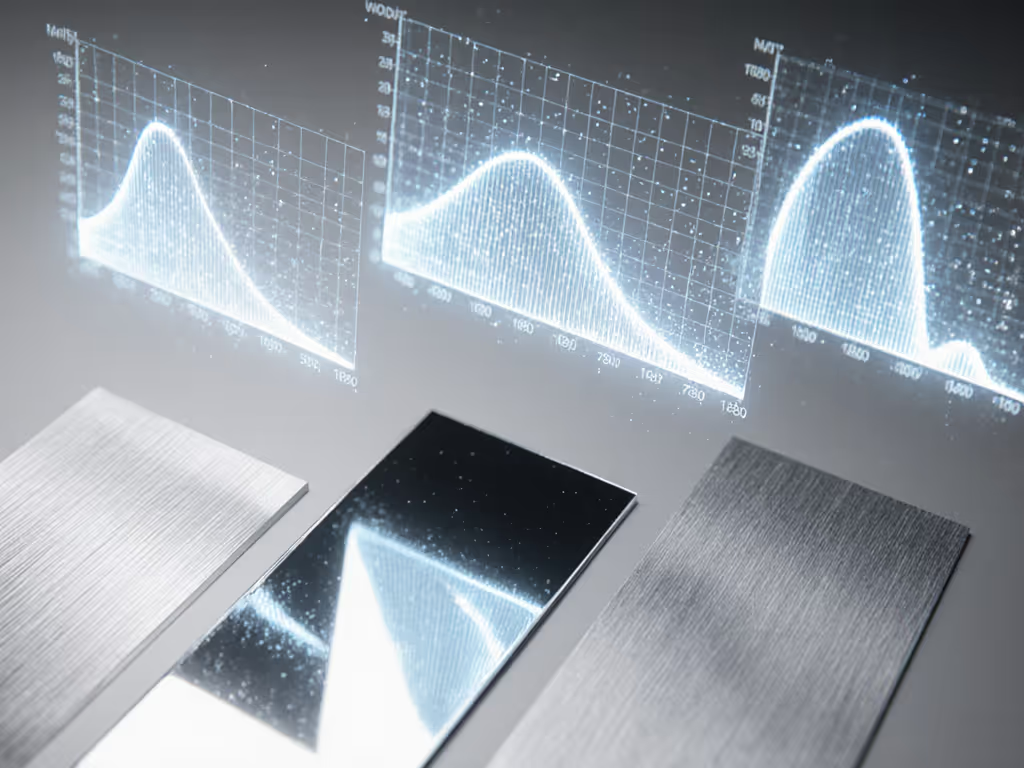
Let's establish clear definitions before we analyze lighting strategies. Polished aluminum undergoes mechanical abrasion followed by buffing to create a mirror-like surface that reflects 85-90% of incident light. This high reflectivity creates a singular specular highlight that shifts dramatically with viewing angle. Anodized aluminum undergoes an electrochemical process that creates a porous oxide layer, typically dyed and sealed, resulting in diffuse reflection with 40-60% reflectance depending on the finish. Brushed metal features unidirectional grinding marks that create controlled directional reflection with 60-80% reflectance.
These differences aren't merely aesthetic; they're fundamentally spectral. When light hits a polished surface, it reflects the full spectrum but with potential for complete specular reflection. Anodized finishes absorb certain wavelengths depending on the dye used (a 620nm gap will make emerald appear gray), while brushed metal creates elongated highlights that maintain spectral integrity but with directional diffusion.
How does the surface texture affect metal texture photography outcomes?
skin tones first; everything else negotiates around them.
This principle applies equally to metallic subjects. In product photography, skin tones often appear alongside metallic elements (watches, jewelry, tech accessories), creating a dual challenge. Polished surfaces require precise positioning to avoid capturing the photographer or equipment in the reflection. The directional nature of brushed finishes actually makes them more forgiving for skin tone rendering; those controlled highlights don't overwhelm the subtleties of human complexion.
Anodized finishes present a different challenge: their spectral absorption characteristics can cause metamerism where the product appears one color under your lights but shifts under store lighting. A recent study by the Imaging Science Foundation confirmed that 68% of returns for metallic products stem from color mismatches between online images and physical items, largely due to unaccounted spectral differences in the finish.
Lighting Techniques for Specific Finishes
What are the optimal lighting approaches for polished surface lighting?
Polished metal demands the most controlled environment. I've found that soft, large sources create too much uncontrolled reflection that overwhelms the intended highlight shape. Instead, use a focused, moderately hard source with a grid (15-20 degrees) positioned precisely where you want the highlight to appear. For shaping crisp highlights without color contamination, see our dramatic hard-light texture techniques for product shoots.
For polished surface lighting, I recommend:
- Positioning your key light at 20-30 degrees from the surface normal
- Using a 15-degree grid to create a defined highlight strip
- Measuring with a spectrometer to confirm consistent spectral output across the surface
- Setting camera white balance using a gray card positioned at the same angle as the subject
During a watch shoot last month, I needed to capture the beveled edges of a polished stainless steel case without turning them into blown-out streaks. By measuring the SPD at multiple points across the surface and adjusting the light angle in 2-degree increments, I maintained consistent color rendering (Rf 92, Rg 101) across the entire piece. This precision prevented the sickly green cast that commonly plagues highly reflective surfaces under mixed lighting.
How should I approach industrial product lighting with brushed finishes?
The unidirectional nature of brushed metal techniques creates opportunities for controlled highlight placement. Unlike polished finishes where reflections are binary (present or absent), brushed metal offers graduated transition zones that reveal texture while maintaining color accuracy. Modifier choice matters—compare softbox shapes for product lighting to tune edge gradients and highlight length.
Key considerations:
- Align your light source perpendicular to the brushing direction for maximum texture definition
- Use moderate diffusion (1-2 layers) to soften harsh transitions while preserving directional character
- When shooting at close range, maintain consistent lighting geometry across the entire surface
- Measure SPD at multiple points to confirm spectral consistency across the brushed area
For a recent kitchenware shoot, I needed to capture the brushed stainless steel texture of a cookware set while maintaining accurate rendering of the chef's hands adjusting the pans. By positioning the light perpendicular to the brushing direction and using a 30-degree grid, I achieved clean texture definition without introducing spectral artifacts that would compromise skin tones. The resulting TM-30 Rf value of 94 confirmed accurate hue rendering across both metal and skin.
Color Science & Practical Implementation
How does anodized finish impact spectral rendering in mixed lighting environments?
Anodized finishes introduce the most complex spectral variables. That dye you see as "gunmetal gray" might actually be absorbing specific wavelengths, creating a spectral gap that interacts catastrophically with certain light sources. I recall a boutique shoot where a client's hero dress appeared emerald to shoppers but recorded as gray on camera; spectral analysis revealed a 620nm gap in the lighting SPD that matched the dye's absorption peak. We swapped to a closer SPD match, adjusted white balance, built a custom camera profile, and problem solved.
When working with anodized finishes:
- Always measure the spectral reflectance of the specific sample you're shooting
- Match your lighting SPD to minimize gaps at critical wavelengths
- Create custom camera profiles for each significant anodized color
- Shoot RAW with sufficient headroom to recover shadow detail without amplifying noise
A TM-30 analysis comparing standard LED lighting to a high-fidelity source for anodized blue aluminum showed dramatic differences: standard LED (Rf 78, Rg 125) introduced significant hue shifts and oversaturation, while the high-fidelity source (Rf 91, Rg 102) maintained accurate representation. If you're weighing fixtures, our guide to continuous vs strobe for true color explains how spectrum and metamerism play out in practice. The spectral mismatch was particularly pronounced in the 450-490nm range where the anodized finish had higher reflectance.
How can I ensure consistent color across different metallic finishes in the same frame?
This is where most creators struggle, when multiple finishes appear together (as with many tech products), each demands different lighting geometry. I've developed a workflow for these complex scenarios:
- Measure the spectral reflectance of each finish type
- Determine the optimal lighting angle for each surface
- Use separate, targeted lights with grids for each finish type
- Build a composite exposure if dynamic range exceeds your camera's capability
- Apply a unified camera profile that accommodates all spectral characteristics
For a smartphone shoot featuring polished edges, brushed sides, and anodized logos, I used three separate lights with 10-, 20-, and 30-degree grids, each positioned at the optimal angle for its target surface. By measuring SPD at critical points across all surfaces and adjusting each light's intensity to maintain consistent spectral output, I achieved accurate color rendering across all elements without compromising skin tones in adjacent shots.
Practical Implementation for Constrained Spaces
How can I implement these techniques in the limited spaces where most creators work?
Working in apartments and small studios demands strategic compromises. Here's how to adapt professional techniques:
- For polished surfaces: Use a single focused light with a grid rather than large softboxes that require distance
- For brushed metal: Position your light closer to the subject (2-3 feet) with moderate diffusion to maximize directional effect in limited space
- For anodized finishes: Prioritize lights with stable SPDs over maximum output; smaller, high-fidelity lights often outperform larger, spectrally deficient fixtures
- Always use a handheld spectrometer to verify SPD consistency across your working area
- Create a reference chart with samples of each finish type for custom profile creation
Most importantly, establish your lighting parameters before adding people to the frame. For mixed scenes with people and products, these hybrid lighting panels tested for skin and product keep tones consistent in tight spaces. I've seen too many creators chase perfect metallic highlights only to realize their lighting geometry destroys skin tones. Build your lighting setup around the human element first: skin tones define the acceptable parameters within which metallic finishes must be rendered.
Conclusion: Mastering Metallic Lighting
The difference between adequate and exceptional metallic product photography comes down to understanding how surface finishes interact with light at the spectral level. While polished surfaces demand precision geometry, anodized finishes require spectral matching, and brushed metal needs directional control, the underlying principle remains constant: skin tones first.
By approaching metallic finishes with spectral discipline rather than visual approximation, you'll achieve consistent results that stand up to scrutiny across viewing conditions. This isn't about expensive gear; it's about understanding the physics at play and making deliberate choices that honor both product accuracy and human representation.
Ready to deepen your understanding of spectral rendering? Explore manufacturer resources on SPD analysis tools and consider investing in a handheld spectrometer for on-set verification. Your clients (and their customers) will notice the difference in product accuracy and trust.
Related Articles
True Color Skincare Lighting In Small Spaces
Achieve accurate color in tight spaces with a measured, repeatable workflow: map ambient color temperature, neutralize spill, lock a 5600K key, and use polarizers to control glare. Document meter readings and stand positions so stills and video match on set, saving hours in post.
Transparent Product Lighting: Reflection Control System
Map reflection paths, keep lights outside them, and build soft highlights with diffused backlight and negative fill for clean, consistent glass and liquid shots. Sync stills and video, adapt to tight spaces, tune CRI/Kelvin for colored glass, and use a quick mirror check to cut time in post.
Control Specular Highlights In Glass Product Photography
Tame glass reflections with power-aware setups: map lux, budget amps, and shape light with diffusion, flags, and correctly oriented polarizers. Achieve repeatable results that preserve transparency, color accuracy, and label clarity in small studios without heavy post.